 The highest tagged major version is


 README

README

env



Simple lib to parse envs to structs in Go.
Example
A very basic example:
package main

import (
	"fmt"
	"time"

  // if using go modules
  "github.com/syronz/env/v6"

  // if using dep/others
  "github.com/caarlos0/env"
)

type config struct {
	Home         string        `env:"HOME"`
	Port         int           `env:"PORT" envDefault:"3000"`
	IsProduction bool          `env:"PRODUCTION"`
	Hosts        []string      `env:"HOSTS" envSeparator:":"`
	Duration     time.Duration `env:"DURATION"`
	TempFolder   string        `env:"TEMP_FOLDER" envDefault:"${HOME}/tmp" envExpand:"true"`
}

func main() {
	cfg := config{}
	if err := env.Parse(&cfg); err != nil {
		fmt.Printf("%+v\n", err)
	}

	fmt.Printf("%+v\n", cfg)
}
You can run it like this:
$ PRODUCTION=true HOSTS="host1:host2:host3" DURATION=1s go run main.go
{Home:/your/home Port:3000 IsProduction:true Hosts:[host1 host2 host3] Duration:1s}
Supported types and defaults
Out of the box all built-in types are supported, plus a few others that are commonly used.
Complete list:
stringboolintint8int16int32int64uintuint8uint16uint32uint64float32float64stringtime.Durationencoding.TextUnmarshalerurl.URL
Pointers, slices and slices of pointers of those types are also supported.
You can also use/define a custom parser func for any other type you want.
If you set the envDefault tag for something, this value will be used in the
case of absence of it in the environment.
By default, slice types will split the environment value on ,; you can change
this behavior by setting the envSeparator tag.
If you set the envExpand tag, environment variables (either in ${var} or
$var format) in the string will be replaced according with the actual value
of the variable.
Unexported fields are ignored.
Custom Parser Funcs
If you have a type that is not supported out of the box by the lib, you are able
to use (or define) and pass custom parsers (and their associated reflect.Type)
to the env.ParseWithFuncs() function.
In addition to accepting a struct pointer (same as Parse()), this function
also accepts a map[reflect.Type]env.ParserFunc.
env also ships with some pre-built custom parser funcs for common types. You
can check them out here.
If you add a custom parser for, say Foo, it will also be used to parse
*Foo and []Foo types.
This directory contains pre-built, custom parsers that can be used with env.ParseWithFuncs
to facilitate the parsing of envs that are not basic types.
Check the example in the go doc for more info.
Required fields
The env tag option required (e.g., env:"tagKey,required") can be added
to ensure that some environment variable is set. In the example above,
an error is returned if the config struct is changed to:
type config struct {
    Home         string   `env:"HOME"`
    Port         int      `env:"PORT" envDefault:"3000"`
    IsProduction bool     `env:"PRODUCTION"`
    Hosts        []string `env:"HOSTS" envSeparator:":"`
    SecretKey    string   `env:"SECRET_KEY,required"`
}
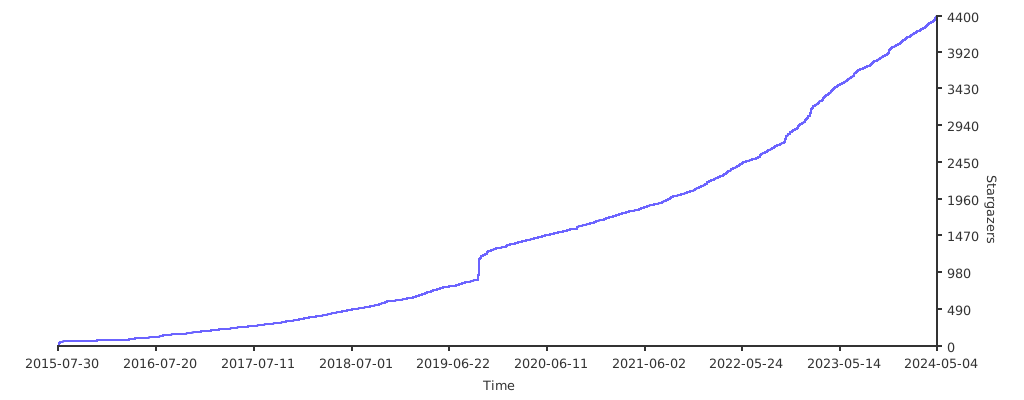
Stargazers over time
 Documentation

Documentation

Index 
Examples 
Constants 
This section is empty.
Variables 
var (
	// ErrNotAStructPtr is returned if you pass something that is not a pointer to a
	// Struct to Parse
	ErrNotAStructPtr = errors.New("env: expected a pointer to a Struct")
)
nolint: gochecknoglobals
Functions 
func Parse 
func Parse(v interface{}) error
Parse parses a struct containing `env` tags and loads its values from environment variables.
Example 
type inner struct {
	Foo string `env:"FOO" envDefault:"foobar"`
}
type config struct {
	Home         string `env:"HOME,required"`
	Port         int    `env:"PORT" envDefault:"3000"`
	IsProduction bool   `env:"PRODUCTION"`
	Inner        inner
}
os.Setenv("HOME", "/tmp/fakehome")
var cfg config
if err := Parse(&cfg); err != nil {
	fmt.Println("failed:", err)
}
fmt.Printf("%+v", cfg)
Output:

{Home:/tmp/fakehome Port:3000 IsProduction:false Inner:{Foo:foobar}}
func ParseWithFuncs 
func ParseWithFuncs(v interface{}, funcMap map[reflect.Type]ParserFunc) error
ParseWithFuncs is the same as `Parse` except it also allows the user to pass in custom parsers.
Example 
type thing struct {
	desc string
}

type conf struct {
	Thing thing `env:"THING"`
}

os.Setenv("THING", "my thing")

var c = conf{}

err := ParseWithFuncs(&c, map[reflect.Type]ParserFunc{
	reflect.TypeOf(thing{}): func(v string) (interface{}, error) {
		return thing{desc: v}, nil
	},
})
if err != nil {
	fmt.Println(err)
}
fmt.Println(c.Thing.desc)
Output:

my thing
Types 
type ParserFunc 
ParserFunc defines the signature of a function that can be used within `CustomParsers`
 Source Files